What Is the Plum Blossom Oracle, and How Do I Ask It a Question?
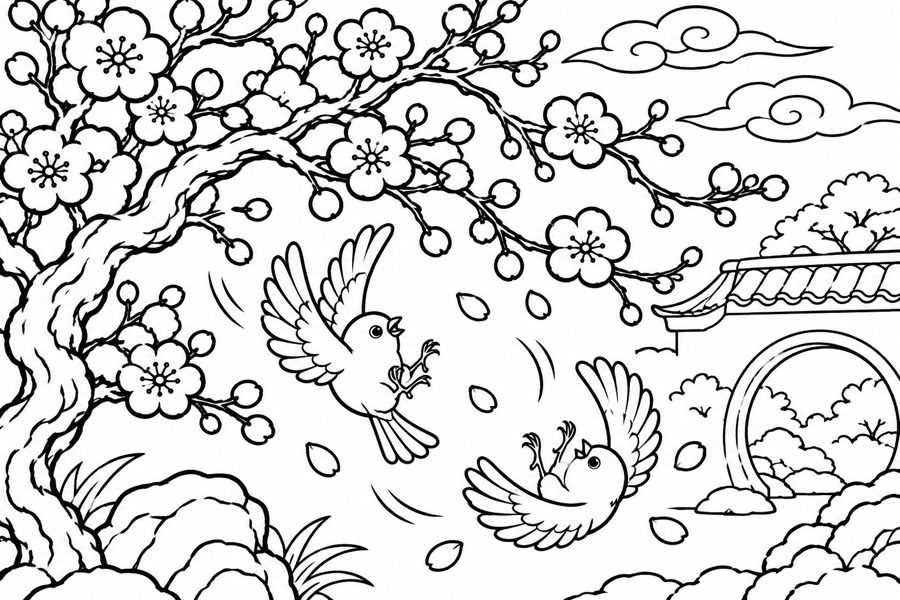
About a thousand years ago, the Chinese scholar Shao Yong saw two sparrows fight over a plum branch and fall to the ground. Birds do not usually fall like that, so he turned the moment into numbers, built a hexagram and predicted that a young woman would come to pick plum blossoms the next evening and hurt her leg. She did. The method has been called the Plum Blossom Oracle ever since.
What you need
One sincere question, three numbers and a few calm minutes. No coins, no cards, no special tools.
How to cast it
- First number: divide by 8 and keep the remainder (0 counts as 8). That is the upper trigram.
- Second number: divide by 8 the same way. That is the lower trigram.
- Third number: divide by 6 (0 counts as 6). That is the moving line, counted from the bottom.
| Number | 1 | 2 | 3 | 4 | 5 | 6 | 7 | 8 |
|---|---|---|---|---|---|---|---|---|
| Trigram | Sky | Lake | Fire | Thunder | Wind | Water | Mountain | Earth |
The secret: you and your question
The trigram without the moving line stands for you. The trigram with the moving line stands for the matter you asked about. Each trigram belongs to one of the five elements, and the way the two elements treat each other is the heart of the answer: if the question's element feeds yours, things lean in your favor; if it controls yours, it is a time to pause and protect yourself.
A quick example
Emily asks about a new job and thinks of 6, 2 and 4. Six is Water on top, two is Lake below, and line 4 moves. That is hexagram 60, Healthy Limits. Line 4 sits in the upper trigram, so Water is the job and Lake is Emily. Lake is Metal, and Metal feeds Water: the move costs her effort at first. When line 4 flips, the upper trigram becomes Lake, the same element as Emily, so the matter ends in harmony.
See the book →